
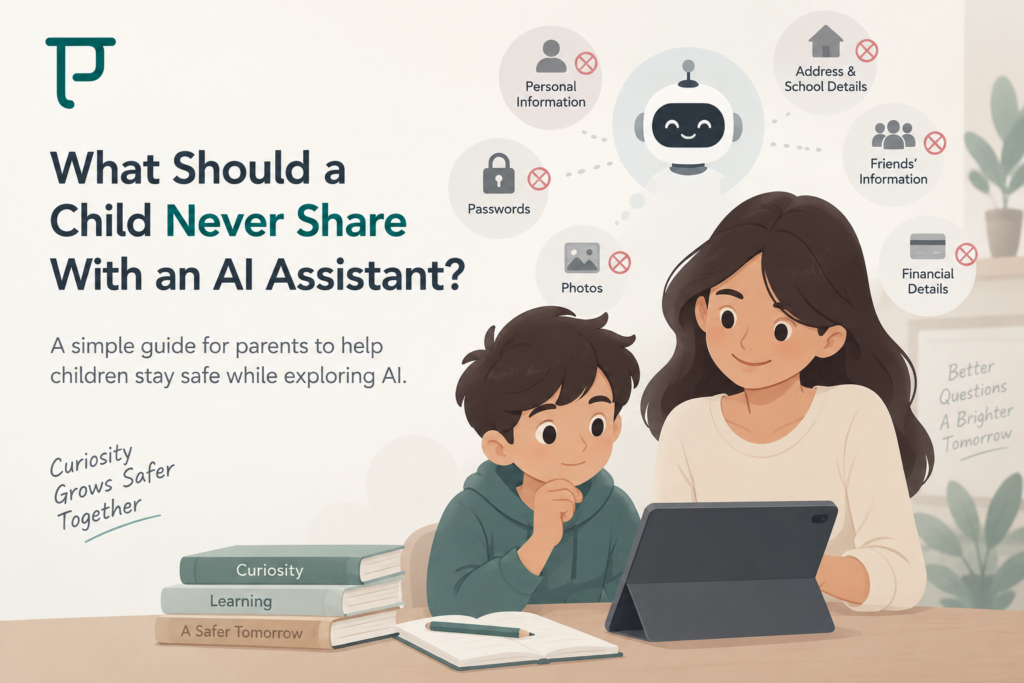
Children are naturally curious.
They ask questions, tell stories, describe what happened at school, talk about their friends, and sometimes share things they would not say out loud to an adult.
When children use AI, that same openness can continue.
That is why one of the most important digital habits parents can teach is simple:
Not everything should be shared with AI.
AI can be useful for learning, creativity, homework help, and exploring ideas. But children should also understand that an AI conversation is still a digital interaction.
Start with one simple family rule
A useful rule for children is:
If you would not write it on a public notice board, think twice before typing it into an AI app.
This does not mean children should be afraid of technology.
It simply teaches them to pause before sharing personal information.
That pause can become an important habit for life.
1. Full name, address and school details
Children should avoid sharing information such as:
- their full home address
- exact school name and class details
- phone numbers
- personal email addresses
- daily travel routes
- locations where they regularly spend time
A child may not see this information as sensitive.
To them, saying “I go to this school and live near this park” may feel completely normal.
Parents can explain that personal information is like a house key.
You do not give it to everyone you meet.
2. Passwords and account information
This one should be very clear.
Children should never give an AI assistant:
- passwords
- PINs
- verification codes
- banking information
- gaming account credentials
- parent account details
A simple phrase children can remember is:
“Passwords are only for me and my trusted adult.”
3. Private family information
Children sometimes talk openly about family situations.
They may mention finances, arguments, travel plans, where parents work, or when nobody will be home.
Teaching privacy does not mean telling children to hide their feelings.
The goal is to help them understand the difference between:
“I am worried because my parents argued today.”
and
“My parents are away until Friday and I am staying at this address.”
One is about emotions.
The other reveals unnecessary personal information.
4. Photos containing personal clues
Children may upload photos without noticing what appears in the background.
A picture can contain:
- a school badge
- house number
- street sign
- vehicle registration
- ID card
- family documents
- another child who did not agree to be photographed
Before uploading a photo anywhere, children can learn to ask:
“Is there anything private visible in this picture?”
That is a useful habit far beyond AI.
5. Information about friends
Privacy does not apply only to the child using the device.
Children should also avoid sharing another person’s:
- phone number
- address
- private photo
- secrets
- medical information
- embarrassing personal details
A good rule is:
Your friend’s private information belongs to your friend.
This helps teach both privacy and respect.
6. Anything that makes them uncomfortable
Children will occasionally come across conversations that feel confusing, strange, embarrassing or uncomfortable.
They should know they can stop.
They do not need to continue answering questions simply because an app asked them something.
Parents can teach:
“If an AI conversation starts feeling strange, stop and talk to someone you trust.”
That trusted person might be a parent, teacher, guardian or another responsible adult.
Parents do not need to become technology experts
Children need guidance more than technical explanations.
You can start with a five-minute family conversation:
“What information about you is private?”
“What would you never tell someone you just met?”
“What should you do if an app asks something that feels uncomfortable?”
“Who can you talk to if you are unsure?”
These conversations help children build judgment rather than simply memorize rules.
Privacy is a skill children can learn
We teach children not to share their house keys with strangers.
We teach them to look before crossing the road.
Digital privacy deserves the same kind of everyday learning.
AI will likely become a normal part of childhood for many children.
The goal should not be to make them afraid of using it.
The goal is to help them become curious, confident and careful users of technology.
At Pratvim, we believe children should be able to explore AI while learning one of the most important lessons of the digital world:
You can be curious without giving away your privacy.