
AI is becoming part of childhood in much the same way search engines, smartphones, and streaming once did.
For many families, the question is no longer simply, “Should children use AI?”
A more useful question may be:
What habits do we want children to develop while using it?
Because healthy AI use is not only about what an AI assistant says. It is also about what a child learns to do before, during, and after the conversation.
Here are a few simple habits families can build together.
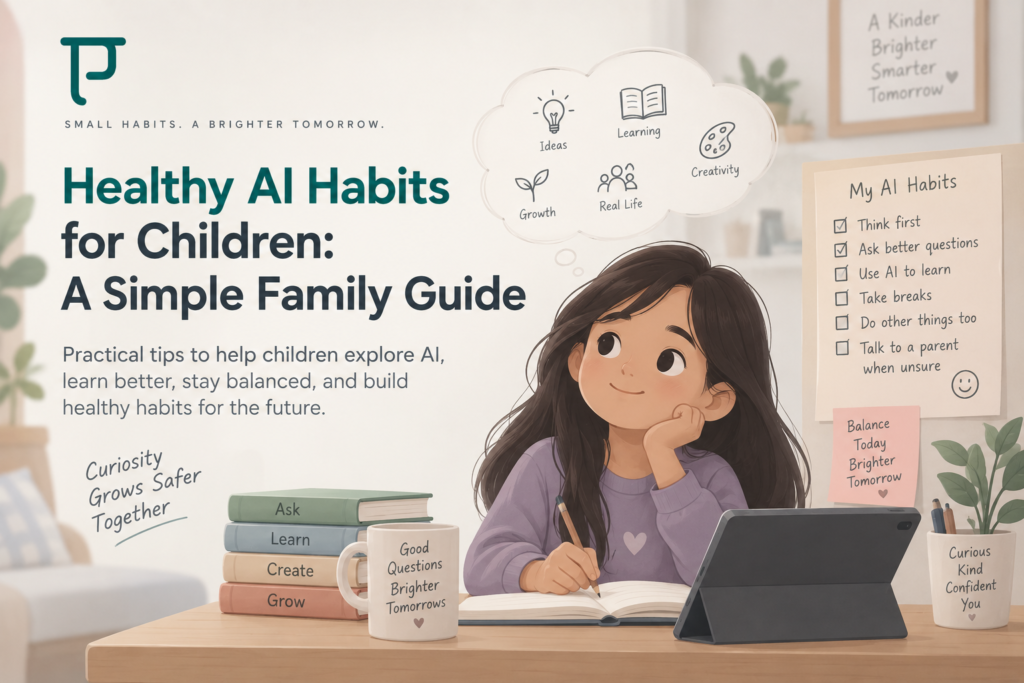
1. Think before asking
When an answer is only seconds away, it is tempting to ask immediately.
Try encouraging your child to pause first.
If they are solving a maths problem, ask:
“How would you start?”
If they are writing a story:
“What ideas do you already have?”
If they are researching something:
“What do you already know about it?”
The child does not need to know the answer. The purpose of the pause is simply to give their own brain the first turn.
A useful family rule can be:
Think first. Ask second.
2. Ask AI to explain, not just answer
There is a big difference between:
“Give me the answer.”
and:
“Help me understand how to solve this.”
One finishes a task.
The other can support learning.
Encourage children to ask things like:
“Can you explain this more simply?”
“Can you give me an example?”
“Why does that happen?”
“Can you give me a hint without telling me the answer?”
These small changes can turn AI from a shortcut into a learning tool.
3. Keep asking, “Does that make sense?”
AI can sound confident even when an answer is incomplete or incorrect.
Children therefore need something more important than knowing how to use AI:
They need to feel comfortable questioning it.
When your child receives an answer, occasionally ask:
“Does that sound right to you?”
“How could we check?”
“Would your teacher or book say the same thing?”
This teaches a powerful lesson.
Technology can provide information.
The child still needs judgment.
4. Don’t let every question become an AI question
Some questions are better answered by experience.
Wondering why a plant bends toward the window?
Watch it for a few days.
Want to know whether adding more water changes a paper aeroplane experiment?
Try it.
Curious about grandparents’ childhood?
Ask them.
AI can explain the world, but children should still touch it, observe it, experiment with it and talk to people in it.
Not every moment of curiosity needs a screen.
5. Make room for boredom
Boredom is not always something that needs to be fixed.
A quiet afternoon can become a drawing.
A cardboard box can become a spaceship.
A few sticks can become a game.
An unfinished thought can become a story.
If AI immediately supplies ideas whenever a child feels stuck, children may get fewer opportunities to discover their own.
Sometimes the best response to:
“I don’t know what to make.”
is simply:
“Try something.”
6. Take breaks without making them a punishment
Healthy technology habits are easier to build when breaks feel normal.
Instead of:
“You’ve been on that thing too long!”
families can create natural stopping points.
Finish one activity, then stretch.
Ask a few questions, then go outside.
Research something, then explain it to another person.
Use AI to plan an experiment, then put the device away and actually do it.
The message becomes:
Technology is one part of the day, not the whole day.
7. Bring AI conversations into family conversations
You do not need to understand every new AI tool your child discovers.
Try simply asking:
“What interesting thing did you ask AI today?”
That question can lead almost anywhere.
Maybe your child discovered something about space.
Maybe an answer seemed strange.
Maybe they created a character.
Maybe they asked something they were embarrassed to ask elsewhere.
The goal is not constant monitoring.
It is creating a family environment where children know that technology does not have to be a private world separate from their parents.
The habit matters more than the tool
Today’s AI tools will change.
New apps will appear. Interfaces will change. Capabilities will improve.
But the habits children develop can last much longer.
Think before asking.
Ask to understand.
Question the answer.
Create something yourself.
Spend time away from the screen.
Talk to people you trust.
Children do not need to become afraid of AI.
And they do not need to become dependent on it either.
There is a healthier middle ground where technology supports curiosity while children continue developing something far more important:
their own ability to think, imagine, learn and grow.